
Chain Link Fence Height Guide
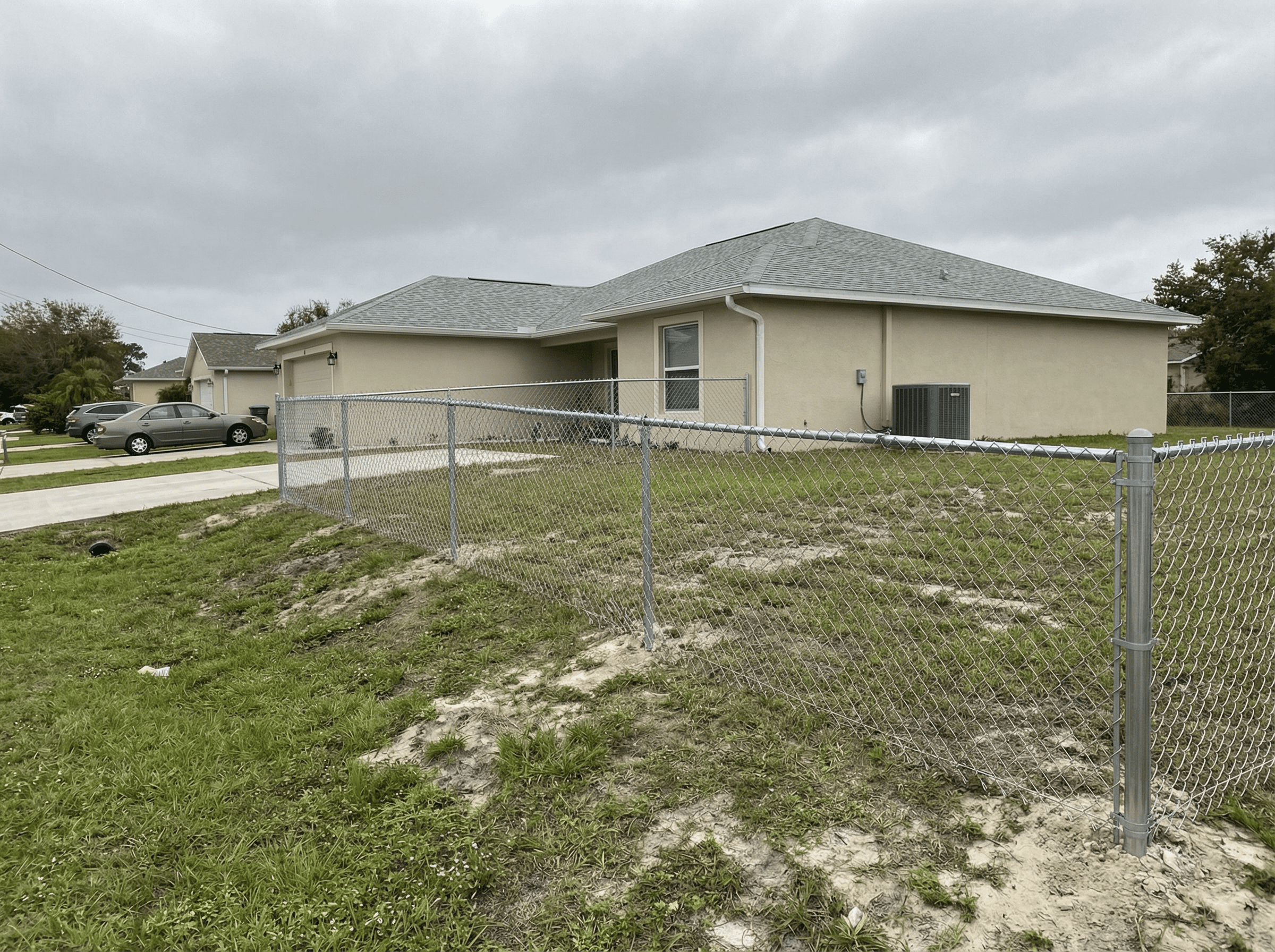
How tall are chain link fences? Chain link fencing comes in set fabric heights, and local rules in Tampa-area jurisdictions set maximum fence heights by yard location and zoning. This guide gives you clear height numbers, what they mean on your property, and what to choose for pets, kids, pools, privacy add-ons, and security.
Here is why: the “right” chain link fence height has two parts. Part one is what you can buy (standard fabric heights). Part two is what you can legally install (city and county fence rules).
Next steps: start with the quick answers below, then match your goal to a height that fits your yard and your local limits.
Quick answers: how tall are chain link fences?
How tall are chain link fences for homes?
4 feet, 5 feet, and 6 feet.
How tall are chain link fences for side and back yards in many residential areas?
6 feet.
How tall are chain link fences for higher-security uses?
8 feet, 10 feet, 12 feet, and up to 20 feet.
How tall are chain link fences you can actually buy as “standard” fabric rolls?
3 feet, 4 feet, 5 feet, 6 feet, 7 feet, 8 feet, 10 feet, and 12 feet.
Let’s break it down.
Standard chain link fence heights you can buy
How tall are chain link fences from a materials standpoint? Chain link fabric gets manufactured and sold in set heights. You choose a fabric height, then the installed fence height follows that choice.
Standard fabric heights (common availability)
You can buy chain link fabric in these common heights:
- 3 ft
- 4 ft
- 5 ft
- 6 ft
- 7 ft
- 8 ft
- 10 ft
- 12 ft
- Up to 20 ft (specialty applications)
This matters because “how tall are chain link fences” often means “what sizes exist without custom ordering.” These heights exist as stocked options from chain link component suppliers and fabric sellers.
Next steps: pick a height that fits your goal, then confirm your front yard vs side/back yard limits before you order materials.
Tampa fence height rules that affect chain link fence height
How tall are chain link fences allowed to be in Tampa? In the City of Tampa code section on fence and wall regulations, residential front yard limits are lower than side and rear yard limits, and the allowed maximum height changes based on what the residential lot borders.
City of Tampa: front yard height limits (residential uses)
Opaque fences in required front yards: 3 feet.
Transparent fences in required front yards: 4 feet.
Chain link counts as a transparent fence style in practice because it does not block light and visibility. So if your chain link fence sits in a required front yard area, the number to plan around is 4 feet.
City of Tampa: maximum fence height behind the front yard
6 feet: single-family and multi-family districts when adjacent to a residential use.
8 feet: single-family and multi-family districts when adjacent to, or separated by an alley from, a non-residential use.
8 feet: office, commercial, and industrial districts (with site plan rules in certain districts).
So when you ask, “how tall are chain link fences” in Tampa, the correct answer depends on where the fence sits and what your property borders.
Next steps: if your fence will run along the street-facing part of the yard, treat it as a front-yard fence and plan for 4 feet for chain link. If the fence is in the side or back yard, plan for 6 feet unless your property line meets a non-residential use or an alley rule allows 8 feet.
Hillsborough County permit guidance that affects chain link fence projects
How tall are chain link fences that need permits in Hillsborough County? Permit rules and zoning rules are not the same thing. Zoning sets height and placement limits. Permitting sets when the county wants plan review.
Hillsborough County publishes a “work exempt from permits” list that includes privacy fencing made out of PVC, wood, or chain link, with a note to check additional building project details and local restrictions. That means some fence work can be exempt from permits in certain cases, yet you still must follow your zoning and community rules.
Next steps: treat this as a two-check system.
- Check your zoning and neighborhood rules for height and placement.
- Check permitting rules for when a permit or review applies.
Nearby Pinellas County rules that many Tampa Bay homeowners run into
If you live in Pinellas County and still search “how tall are chain link fences,” the numbers can change.
Pinellas County’s fence and wall standards spell out residential height limits by yard area:
- Side and rear setback areas: 6 feet (any style), with an 8-foot decorative option along certain road frontages
- Front setback area: 3 feet (any style)
- Front setback area decorative: 4 feet, with toppers allowed up to 5 feet total in defined cases
So “how tall are chain link fences” in Pinellas often points to 3 feet in the front setback and 6 feet in side and rear setback areas.
Next steps: if you are in Tampa, use Tampa rules. If you are outside Tampa city limits, use your county and municipality rules.
How tall are chain link fences for pets?
How tall are chain link fences for dogs? The correct height is the one that stops jumping and climbing for your specific dog.
Use these direct picks:
- 4 feet: Yes for small dogs that do not jump fences.
- 5 feet: Yes for medium dogs that jump low barriers.
- 6 feet: Yes for large athletic dogs and dogs that test boundaries.
If your dog climbs chain link, height alone will not fix it. Climbing uses the mesh like a ladder. You need a climb-resistant plan: tighter mesh, a smooth top rail, and a top extension that blocks grip.
Next steps: tell us the dog’s breed and weight range, and we will recommend a chain link fence height that fits your yard limits and your dog.
How tall are chain link fences for kids and play areas?
How tall are chain link fences that keep kids in a yard? 4 feet works for basic boundary control. 5 feet adds margin. 6 feet is the clean answer when you want fewer worries and you have side/back yard placement.
If the fence is near a street, drive aisle, canal, or pond, pick 6 feet where allowed. If it must sit in the front yard, use 4 feet chain link and place it correctly, since front-yard limits can cap you.
Next steps: decide whether the goal is “boundary reminder” or “hard barrier.” Hard barrier points to 6 feet.
How tall are chain link fences for pools in Florida?
How tall are chain link fences for pool safety? Yes, a taller fence is required in practice because pool barrier rules focus on preventing unsupervised access. Pool barrier standards often target a fence height around the 4-foot range and above, with strict rules about gaps, climb points, and gates.
If you plan a chain link pool enclosure, treat it as a dedicated safety barrier project. That means you plan the fence height, the gate type, the latch height, and the ground clearance together. Code-based pool barrier details vary by jurisdiction and inspection process.
Next steps: if your fence is for a pool, do not guess. We will check your property’s jurisdiction and build a pool-compliant plan.
How tall are chain link fences for privacy?
How tall are chain link fences for privacy? Chain link alone does not give privacy. The height does not change that fact. The privacy comes from what you add to the chain link.
Here are your privacy options that work with chain link:
- Privacy slats in the mesh
- Privacy screen fabric attached to the fence
- Landscape screening set behind the fence line
So if your real question is “how tall are chain link fences for privacy,” the clean answer is: 6 feet plus a privacy add-on for side and back yards where allowed.
Next steps: choose the fence height first, then choose the privacy method that fits your budget and wind exposure.
Security height: how tall are chain link fences for deterrence?
How tall are chain link fences for security? 8 feet is the starting point for stronger deterrence. 10 feet and 12 feet push the fence into controlled-access territory. 20 feet exists for high-security sites.
Security height planning also includes the top detail:
- Top rail only: cleaner look, fewer sharp hazards
- Tension wire or top guard: increases climb resistance
- Barbed wire or razor wire: restricted by zoning and approval rules in many areas
In Tampa’s rules for certain fencing types, barbed wire placement starts at a minimum elevation of 6 feet above the ground in the contexts where it is allowed, and razor wire can trigger a variance process. That means height and top detail tie directly to local approval.
Next steps: if you want security height, plan the fence as a system: height, mesh, posts, spacing, and top detail.
Height vs strength in Florida wind: the part many people miss
How tall are chain link fences before wind becomes a bigger deal? Wind loads increase fast as height rises, and chain link behaves like a porous surface that still catches wind.
Two reputable references guide the wind conversation in Florida:
- Florida building code training material includes a fence wind design note for fences not exceeding 6 feet from grade.
- The Chain Link Fence Manufacturers Institute publishes a wind load guide that ties fence height, wind speed, mesh type, and post spacing into one set of calculations.
Here is why: fence failures in storms usually come from weak posts, shallow footings, wide spacing, and poor bracing, not from the fabric itself.
What changes as height increases?
As the chain link fence height goes up:
- You need larger line posts
- You need stronger terminal posts and braces
- You need deeper and wider footings
- You often need tighter post spacing, based on wind speed and exposure
So “how tall are chain link fences” also becomes “how tall are chain link fences that stay standing.”
Next steps: if you want 7 feet, 8 feet, 10 feet, or 12 feet, plan for engineering-grade installation choices, not a light residential build.
How tall are chain link fences in the front yard?
Chain link fences in the front yard are typically 4 feet.
That answer comes from the front yard limit for transparent fences. Chain link is a transparent fence style because it allows visibility.
If you want the fence taller than that, move it out of the required front yard area where your zoning allows it, or use an approved layout tied to your exact zoning district.
Next steps: mark your required front yard line before you build. That line often sits back from the sidewalk or curb. If you place the fence in the wrong spot, you can end up with a compliance problem even if the fence height is normal.
How tall are chain link fences in side yards and back yards?
How tall are chain link fences in side yards and back yards in Tampa? 6 feet for residential lots next to residential uses.
That number is the common cap for residential adjacency. Tampa also allows 8 feet in the stated case where a single-family or multi-family district sits next to, or across an alley from, a non-residential use.
Next steps: if your yard backs up to a commercial parcel, a retention area tied to a commercial site, or an alley next to non-residential land, your allowed height can change. We can confirm that from your address and zoning.
Measuring chain link fence height the right way
How tall are chain link fences when inspectors measure them? They measure from grade to the top horizontal member, with local rules defining grade and special cases.
Pinellas County’s measurement rule states height is measured from the lowest adjacent grade to the uppermost horizontal member, and it also addresses strands above height limits in defined cases.
Tampa’s rules include a method of measurement when a fence sits at a common property line with varying elevation. It measures and averages height at regular intervals.
Next steps: if your yard slopes, do not assume the height is “6 feet everywhere.” The measured height can exceed the limit at the low point if you do not step the fence or grade correctly.
Picking the right chain link fence height in Tampa by goal
How tall are chain link fences you should choose for a Tampa home? Use this simple selector.
Goal: keep a small dog in
Pick 4 feet if the fence is not in a front-yard restricted area and your dog does not jump.
Pick 5 feet if you want margin.
Goal: keep a large dog in
Pick 6 feet in a side or back yard.
Goal: boundary fence along the front
Pick 4 feet chain link in the required front yard area.
Goal: backyard security upgrade
Pick 6 feet if residential adjacency caps you.
Pick 8 feet only when your lot conditions allow it and you build for wind.
Goal: sports area, equipment yard, or controlled access
Pick 8 feet, 10 feet, or 12 feet based on the site’s security need and wind design plan.
Next steps: decide your goal, then confirm the location on your lot where the fence will sit. Height follows that decision.
Cost and appearance: what height changes in the real world
The cost of chain link fencing rises at every height step, and it rises again when you move into heavier posts and deeper footings.
Here is what changes as you go taller:
- More steel weight in posts and rails
- More concrete in footings
- More labor time for setting and bracing
- More gate hardware cost for taller gates
Appearance also changes with height. A 6-foot chain link fence reads as a full perimeter barrier. A 4-foot chain link fence reads as a boundary marker. That matters for curb appeal and neighbor expectations.
Next steps: tell us whether you care more about containment, look, or security. We will match height to that priority.
Common mistakes that lead to “wrong height” problems
If you search “how tall are chain link fences,” you may worry about buying the wrong size. These are the mistakes that cause problems in Tampa Bay:
- Building a front-yard fence too tall
That triggers a compliance issue fast. - Ignoring slope measurement
A “6-foot fence” can measure higher at the low end. - Choosing height without upgrading posts
A taller fence with light posts can fail in wind. - Assuming county rules match city rules
Tampa, unincorporated Hillsborough, and nearby counties can set different limits.
Next steps: treat height as part of a full plan: location, rules, wind, posts, gates, and purpose.
Tampa Bay FAQ: how tall are chain link fences?
How tall are chain link fences in residential backyards in Tampa?
6 feet.
How tall are chain link fences allowed in a required front yard in Tampa?
4 feet.
How tall are chain link fences that come in standard material sizes?
3, 4, 5, 6, 7, 8, 10, 12, and up to 20 feet.
How tall are chain link fences for large dogs?
6 feet.
How tall are chain link fences for security perimeters?
8 feet, 10 feet, or 12 feet.
How tall are chain link fences before wind design becomes more demanding in Florida?
Over 6 feet.
Ready to choose the right height for your yard?
How tall are chain link fences on your property in Tampa depends on two facts: your fence location on the lot and your zoning rules. If you want the fence to look right and pass review, you need both.
Local Choice Fence installs chain link fences across the Tampa area, including Hillsborough, Pinellas, Pasco, and Hernando. Tell us your address, your goal, and where you want the fence line. We will recommend a chain link fence height that fits your yard and your local limits.
Sources
- Amendment 23-4: Section 27-290.1 Fence height in residential districts
Publisher: City of Tampa
Publication Date: March 22, 2023
URL: https://www.tampa.gov/document/amendment-23-4-section-27-2901-fence-height-residential-districts-posted-3-22-23-117601 - Sec. 27-290.1. Fence and wall regulations (PDF)
Publisher: City of Tampa
Publication Date: March 22, 2023 (posted)
URL: https://www.tampa.gov/sites/default/files/document/2023/section_27-290.1_fence_height_in_residential_3-22-23.pdf - Work Exempt from Permits
Publisher: Hillsborough County, Florida
Publication Date: August 7, 2025
URL: https://hcfl.gov/businesses/permits-and-records/permits/work-exempt-from-permits - Article X Division 4: Fences and Walls (Revised 10-2022) (PDF)
Publisher: Pinellas County, Florida
Publication Date: October 2022 (revision date shown in document)
URL: https://pinellas.gov/wp-content/uploads/2023/01/Article_X_Division_4_Fences_and_Walls_102022.pdf - F567 Standard Practice for Installation of Chain-Link Fence
Publisher: ASTM International
Publication Date: June 23, 2023
URL: https://www.astm.org/f0567-14ar19.html - Chain Link Fence Wind Load Guide for the Selection of Line Post and Line Post Spacing (WLG 2445) (Updated January 2023) (PDF)
Publisher: Chain Link Fence Manufacturers Institute
Publication Date: January 2023
URL: https://chainlinkinfo.org/wp-content/uploads/2023/02/WLG-Final-2.12-23-ml.pdf - Florida Building Code Commission Education Material (fences wind design excerpt)
Publisher: Florida Building Commission / FloridaBuilding.org
Publication Date: August 2015 (file set context shown on publication page)
URL: https://www.floridabuilding.org/fbc/commission/FBC_0815/Commission_Education_POC/732/732-0-MATERIAL.pdf


